University of Texas
ECE

Latest ECE News

Research Review 2nd Annual Computer Architecture and Embedded Processors
Research Review for Industry

Tues, Aug 26
9 AM - 5 PM
Avaya Auditorium ACES 2.302

The research faculty and their PhD students in computer architecture and embedded processors will present a snapshot of their research. Admission is free, but we ask that you register to give us an accurate count for the coffee breaks.
REGISTER NOW


EE 464 Senior Lab

Senior Lab Senior Lab Senior Lab Senior Lab Senior Lab Senior Lab
Photos by Daryl Goodnight

EE 464 Senior Lab Winners

Senior LabFirst Place
Anti-Collision Simulator
Aaron Kravoletz, Alfredo Moreno Jr., Vanessa Tolentino, Alex Adams Mucha
TA: Youngsang Kim

Senior LabSecond Place
Position Locator of Football near Goalline
Donovan Barroso, Adam Miller, Eduardo Martinez, James Nelson Murdock
TA: Yeojoon Kim

Senior LabThird Place
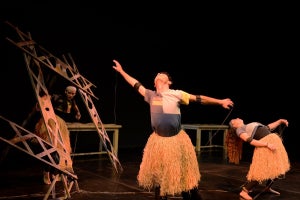
Simple Simon Dance
Faye Workman, Bobae Cheney, Daryl Shu Hern Liew, Adam Burstyn
TA: Goo Jun

Senior LabFourth Place
Personal Locator with GPS and RFID
Wade Becker, Hani Ebeid, James Reggio
TA: Goo Jun

Senior LabFifth Place
Wireless Patient Monitoring System
David Shields II
Ralph Roger Smith
TA: Sanghyun Chi

Senior LabSixth Place
Remote Robot Control by Graphical Path Interpretation
Yang Wei, Jennifer Kam, Arthur Wong, Trevor Brian Hird
TA: Yeojoon Kim

Photos by Daryl Goodnight

Orshansky writes Circuit Design Book

ECE professor, Michael Orshansky, has just published a book on the emerging techniques for design for manufacturability. Manufacturability has become a crucial challenge in the design of nanometer scale integrated circuits and systems. The book—co-authored by IBM researcher Dr. Sani Nassif and MIT professor Duane Boning—is entitled Design for Manufacturability and Statistical Design: A Constructive Approach. The book advances the first comprehensive treatment of the causes of variability, methods for statistical data characterization, and techniques for modeling, analysis, and optimization of circuit yield.

"Our book can be used as a textbook, but we were also writing it with researchers and working engineers in mind," says Dr. Orshansky.

ECE Professor Seth Bank has just been selected to receive the 2008 Young Investigator Award that is presented by the North American Molecular Beam Epitaxy (NAMBE) Advisory Board. The award will be presented at the 2008 NAMBE conference, which is being held in Vancouver, Canada on August 3-8.

NAMBE's Young Investigator Award recognizes individuals who, by the age of 35, have made significant contributions to the science and technology of molecular-beam epitaxy or to science and technology that is enabled by MBE, and who show promise of future leadership in the field. Nominees for the award come from universities, government agencies, and companies worldwide that use MBE technology. Awardees have presented their cited work at one or more NAMBE conferences.

ECE graduate student, Patrick Doody, received a prestigious National Science Foundation (NSF) Graduate Research Fellowship for 2008. Each year NSF offers about 1,000 fellowships nationwide to provide graduate students with up to $40,000 annual support for three years.

Doody is developing a set of metrics to analyze the variability of wind power. This is a particularly timely field of study. Department of Energy policy is for 30% of the nation's energy to be produced by renewable sources by 2030. Wind power is by far the cheapest renewable energy source, but suffers because of it's intermittent nature.

Doody's research focuses on quantifying the wind's variability and determining better wind farm locations—both in terms of typical wind behavior and in terms of balancing that behavior in a grid to ensure, as much as possible, consistent power. Doody studies in Professor Surya Santoso’s Laboratory for Advanced Studies in Electric Power and Integration of Renewable Energy Systems.

3D Wireless Bandwidth

ECE grad student Chulhan Lee, Prof. Sriram Vishwanath, Texas A&M prof Tie Liu, and Intel's Dr. Ozgur Oyman received the Best Paper Award at the 2008 International Conference on Cognitive Radio Oriented Wireless Networks and Communications (CrownCom). Their paper "Limits on Cognitive Communications in the Wideband Regime" proposes a novel solution to the wireless bandwidth needs of the future.

Wireless multimedia applications require significant bandwidth, some of which will be provided by third-generation (3G) services. Even with substantial investment in 3G infrastructure, the radio spectrum allocated to 3G will be limited.

Cognitive radio—an extension of software radio that employs model-based reasoning about users, multimedia content, and communications context—offers a mechanism for the flexible pooling of radio spectrum using a new class of protocols called formal radio etiquettes. This approach could expand the bandwidth available for conventional uses (e.g., police, fire and rescue) and extend the spatial coverage of 3G.

One of Professor Hao Ling's graduate students, Shobha Sundar Ram, won the Best Student Paper Award at the 2008 IEEE Radar Conference. Her paper "Simulation of Human MicroDopplers using Computer Animation Data" outlines a new way to aid tracking human activities through building walls and other non-line-of-sight environments. This technology has important applications in search and rescue missions, law enforcement operations, and surveillance.

Ms. Ram compares existing animation data with Doppler radar data of humans engaged in different activities. Each movement has a unique radar signature called a MicroDoppler. The combination of the two sets of data produce virtual renderings similar to that of a video game.

ECE PhD candidate, Savithri Sundareswaran, Professor Jacob Abraham, Alexandre Ardelea, and Rajendran Panda won one of three best paper awards given at the 9th International Symposium on Quality Electronic Design (ISQED 2008). The paper, "Characterization of Standard Cells for Intra-Cell Mismatch Variations," discusses a new approach to predicting delay variations of gates/cells. Instead of categorizing each device fluctuation separately, the team analyzed the fluctuations in switching and non-switching devices and their impact on delay variations. Using these properties of the devices, they proposed a clustering approach to characterize for cell's delay variations due to intra-cell mismatch variations. The proposed approach results in as much as 12X runtime improvements with acceptable accuracy.

ISQED is a leading electronic design conference focused on innovations dealing with process variations and design margin exploration.

UT alumnus, Steve Poizner (BSEE '78) has had a successful career as a business consultant, an inventor of life-saving technology, a volunteer public school teacher, the founder of several non-profit organizations supporting improved education for disadvantaged students and as a public servant. Today, Poizner is one of California’s highest-ranking elected officials.

  • invented life-saving technology that allowed GPS receivers to be placed in cell phones
  • as Director of Critical Infrastructure in the National Security Council, Poizner was tasked with protecting the nation’s network systems and electrical grids against terrorist attacks
  • taught in disadvanted high school (refused salary)
  • elected to one of California's eight statewide elective offices and now regulates 4th largest insurance market in the world

The Norman Hackerman Advanced Research Program (ARP) received $16.7M from the 80th Texas Legislature and granted almost 20% of it to engineering projects at The University of Texas at Austin. Projects funded at UT-ECE are:

  • Antenna Design for Non-Radiative Wireless Power Transfer
    Prof. Hao Ling
  • Energy-conserved On-chip Nano-scale Opto-Electronic Interconnects for Silicon High Performance VLSI
    Profs. David Pan and Ray Chen
  • Smart Active Context-based Surveillance System
    Profs. J.K. Aggarwal and Kristen Grauman, UT-CS
  • High-Mobility Channel MOSFETs
    Prof. Jack Lee

Professor Ray Chen received an Air Force Office of Scientific Research (AFOSR) Multidisciplinary University Research Initiative (MURI) award worth 4.75 million dollars. Dr. Chen is the lead in a collaborative project to build a laser system.  The system can be used for biomedical sensors and air-borne and space-borne communications. Three other colleges are involved. Fabian Pease at Stanford will work on 3D nano-membrane lithography. John Rogers at the University of Illinois at Urbana-Champaign will work on formation of nano-membrane and Wei Jiang at Rutgers will work on delay time simulation and device fabrication. Dr. Chen's team will work on system design, nanomembrane device fabrication, and system integration and testing.

Dr. Gregory L. Fenves, international expert in structural engineering and former chair of the Department of Civil and Environmental Engineering at the University of California, Berkeley, has been appointed dean of the Cockrell School of Engineering at The University of Texas at Austin.

Fenves’ appointment, which follows an international search, is effective Sept. 1. Fenves, 51, replaces Dr. Ben Streetman who served 12 years as the Cockrell School dean.

"Gregory Fenves is an internationally recognized leader in civil and environmental engineering, and we are enormously pleased that he will take over the leadership of the Cockrell School of Engineering after Ben Streetman’s long and successful deanship,” said William Powers Jr., president of The University of Texas at Austin. “Dean Fenves will inherit one of the premier engineering schools in the nation and we have confidence that under his leadership the school will accomplish even more." More...

Longtime Employees Recognized and Steven Moore Leaves

Staff Lunch Staff Lunch Staff Lunch Staff Lunch Staff Lunch Staff Lunch
Fred Kirby

Senior staff members were recently recognized at a staff luncheon.

  • Charlotte Harris (15 years): "I’m proud to be part of the UT community. I feel lucky to get to work with so many nice people in such a stimulating environment."
  • Michelle Belisle (10 years): "UT is the center of my life right now. It's where I have my career and where I go to school. I'm working towards a master's in Classical Archeology and hope to take my first graduate level class this fall."
  • Melissa Campos (10 years): "I like working at UT because of the diversity on campus and the students. I’ve also worked for several different departments that have shown me how different and unique each one is."
  • Janet Preuss (10 years): "The great thing about working at UT is being part of something bigger. I get to work with people who are literally changing the world. It’s inspiring to be able to make a contribution to the greater good."

Steven Moore, our Sr. Procurement Officer for the last 3 years, has left us to work for the Department of Chemistry and Biochemistry as their Facility and Safety Manager. While this is a great opportunity for Steven, he will be sorely missed. He was—by far—our healthiest staff member, a bike and running enthusiast. He is also extremely funny, organized, and conscientious. We wish him well and hope he doesn't forget us—the little people—in his rise to the top.

Graduate admissions stalwart, Barry Levitch, received the ECE Staff Merit Award. His nominating recommendations pretty much say it all.

  • "Barry’s job has changed completely since he started 12 years ago." says Levitch’s colleague Melanie Gulick. "We’ve gone electronic and Barry was an integral part of that."
  • "When I walk into Barry's office with a question about an applicant, Barry seems to
    immediately know who I'm talking about. We have well over 200 applicants in Solid-State electronics alone this year, yet Barry still seems to know each by name." says Dr. Frank Register.

  • According to Dr. Brian Evans: "Barry single-handedly coordinates the evaluation of roughly 2,000 applications each year by nine different admissions committees. Each admissions committee has a different process and timetable in place, but Barry can fill requests for data within hours and stays calm in the face of the chaos that is graduate ECE admissions."